In this article, I would like to share my journey toward the Project Management Professional (PMP) certification: why I decided to pursue it, how I prepared for the exam, the resources I used, how the exam went, and what comes next.
1. Why I Chose PMP
Early in 2025, I started thinking more seriously about project management skills, as I identified them as essential for someone aspiring to become a CISO.
A Chief Information Security Officer is not only responsible for security strategy but also for leading initiatives, defining projects, and ensuring their successful delivery. I therefore began looking for a certification that could both strengthen the management skills I had developed so far and teach me recognized best practices in project management.
During my research, I came across several certifications such as Professional Scrum Master and Project Management Professional and realized that it covers multiple project management approaches, including predictive and adaptive methods.
Later in the year, something gave me the final push. I saw a post from my friend Malick ALASSANE, who had just successfully passed the PMP exam. I felt this was exactly the path I wanted to follow. We met shortly after in a small corner of Paris, drinking bubble tea and eating pizza while discussing the certification. During that conversation, he answered many of my questions, shared his preparation methodology, and recommended several resources that helped me start my journey.
2. How I Prepared for the Exam
My preparation started with the Andrew Ramdayal PMP certification course on Udemy, which provides the required 35 contact hours to be eligible for the exam.
The course contains more than 300 videos explaining project management according to the Project Management Institute framework, covering both predictive and adaptive approaches.
Progress was not always straightforward. I had to balance learning with my daily work, and sometimes I even found myself falling asleep while watching videos after long workdays.
Before I could finish the course, I had the opportunity in December 2025 (8–12) to attend an intensive five-day live PMP training that also provided the required 35 hours of training. During those five days, we went through the entire PMP syllabus. It was extremely dense, and I knew I had not mastered every topic yet, but that was fine. My plan was simply to review them afterward.
After the training, I went back to the Udemy course and completed it by the third week of January. I also completed all the quizzes twice before moving on to focused exam preparation.
To prepare further, I used several additional resources:
-
Practice questions from the platform provided during the live training
-
Various YouTube resources
-
A detailed exam review written by my friend Malick
At some point, I started feeling overwhelmed by the amount of information. Practicing hundreds of multiple-choice questions can be exhausting, and PMP questions often require careful reasoning.
Once again, meeting Malick helped. We met again over bubble tea and talked about many things unrelated to PMP. That conversation helped me relax and regain perspective.
Initially, I planned to take the exam on February 14, but I decided to postpone it because I did not feel ready.
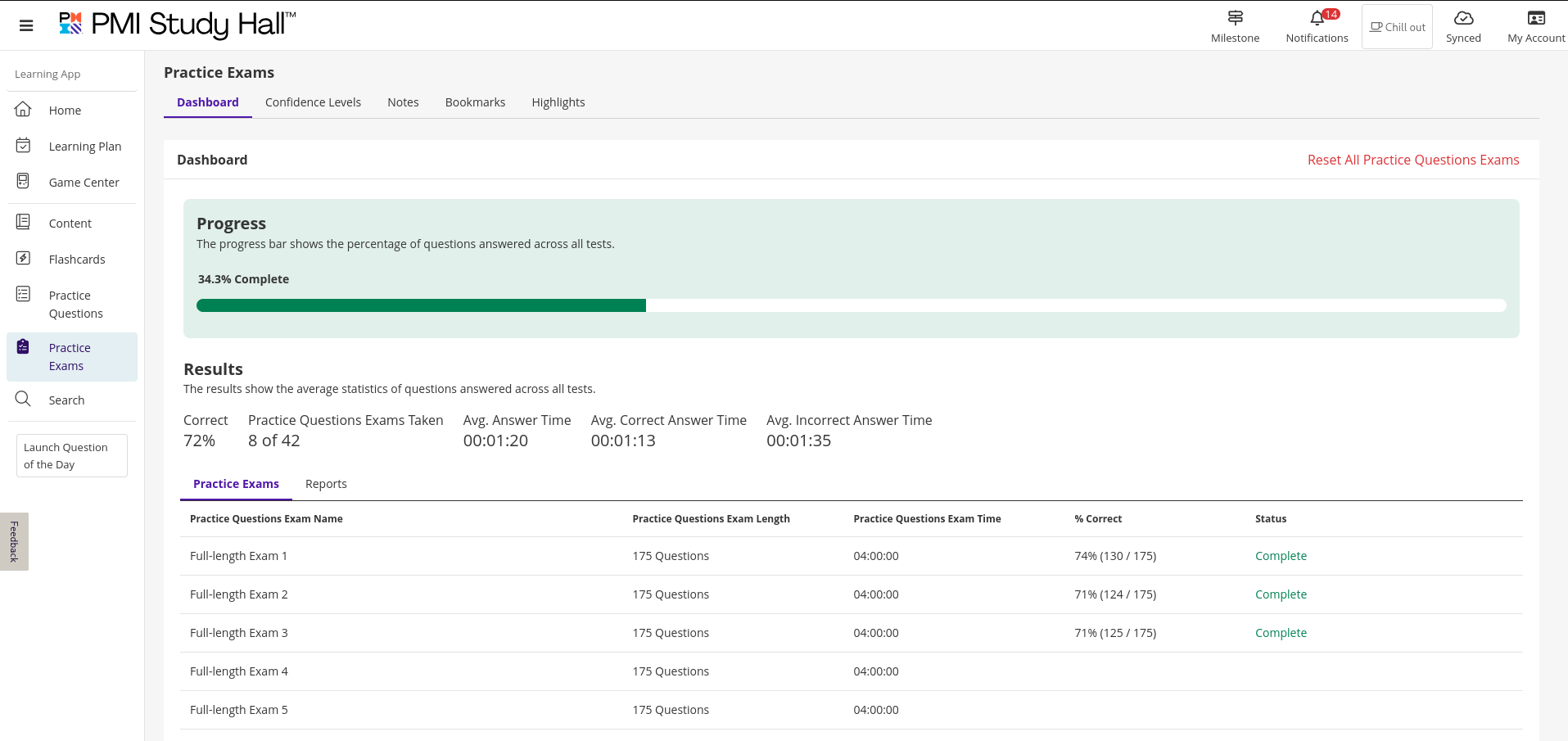
Eventually, after reading many reviews from other PMP candidates, I decided to subscribe to PMI Study Hall, which provides official practice questions.
The platform includes several full-length mock exams of 175 questions that simulate the real exam. I completed three of them and scored:
-
74%
-
71%
-
71%
After each exam, I carefully reviewed my incorrect answers to understand my mistakes.
I completed about 34% of the Study Hall content, and since my overall score was around 70%, I felt confident enough to schedule the exam.
I finally booked it for Thursday, February 26.
At that point, I was honestly exhausted from studying. Most of the preparation material was in English (which is not my first language), and reading long and complex multiple-choice questions every day was mentally demanding.
3. Exam Day
Exam day was extremely stressful. I was not fully confident about passing, and I knew that time management would be critical.
The PMP exam consists of 180 questions, and fatigue can quickly become a factor.
Before starting the exam, I reviewed David McLachlan’s drag-and-drop questions on YouTube, which turned out to be helpful.
I chose to take the exam online from home through Pearson VUE. I connected 30 minutes before the scheduled time, but unfortunately I encountered several technical issues with my computer, microphone problems and camera issues.
That moment was very stressful. I was worried the exam would be canceled. Fortunately, everything eventually worked, although I still have no idea what exactly caused the problem or how I fixed it.
Once the exam started, it was divided into three sections of 60 questions, with optional 10-minute breaks between them.
The first section went slowly. I spent too much time analyzing each question and realized my time management was not ideal. For the next sections, I adjusted my pace to keep up with the schedule.
When the exam finally ended, I felt relieved, but the waiting period began.
Since I took the exam online, the result was not displayed immediately. Instead, I had to wait up to 48 hours to receive the official result by email.
That wait was extremely difficult. I barely slept that night. I woke up several times, worrying about the exam and even having nightmare where I was having possible failure scenarios. I kept checking my phone repeatedly for any email update.
Finally, the next evening (Friday, february 27th ), while I was on the train, I received the email.
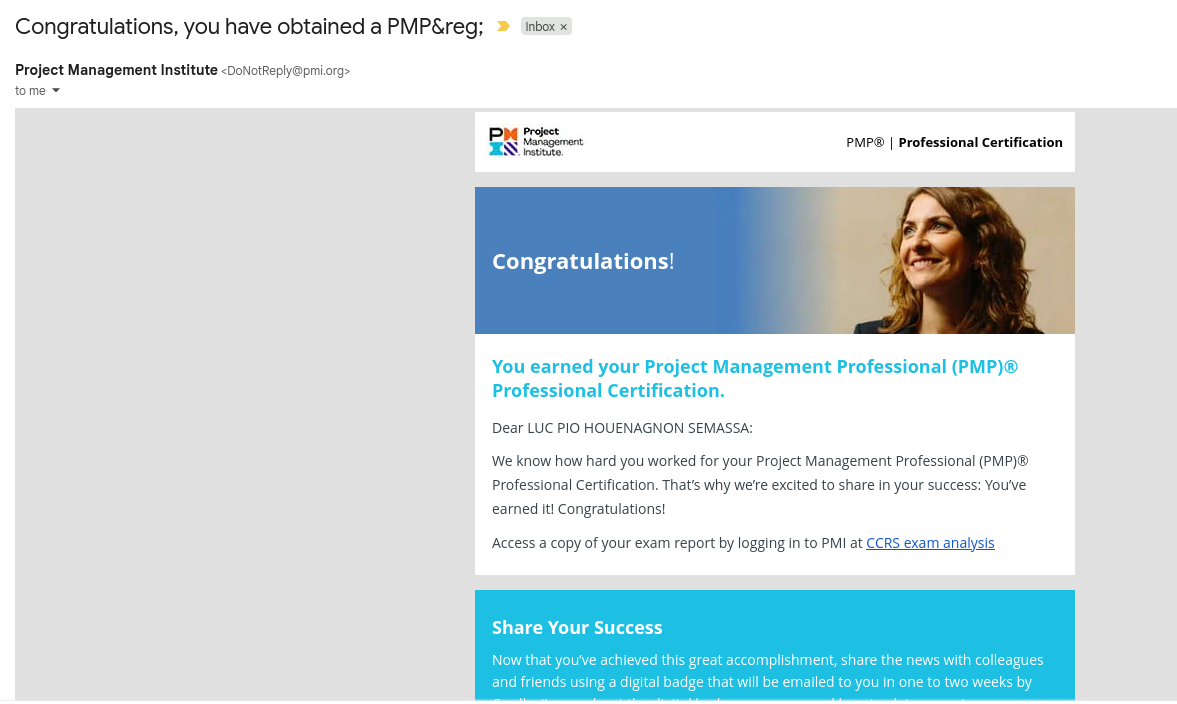
I had passed.
You can imagine the joy and relief I felt at that moment.
4. What Comes Next
Now that I am PMP certified, my goal is to apply these best practices in my daily work and become more structured in managing projects.
My initial objective—strengthening my project management skills—has definitely been achieved. Despite the challenges along the way, I am very glad I decided to pursue this certification.
As a member of the PMI community, I have also applied for a volunteer position as a cybersecurity assistant, since cybersecurity remains my primary domain.
More importantly, this certification feels like an important milestone in my professional journey and a step closer to the CISO role I aspire to.